
If your passport is on the Thailand visa exemption list, you do not need a visa for a holiday of up to 30 days. Since 15 September 2026, travellers from 60 countries and territories, including the UK, the US, Australia, Canada, India and every EU country, can enter visa-free for tourism only. You can ask for one 30-day extension in Thailand. For anything longer or for work, you need a proper visa.
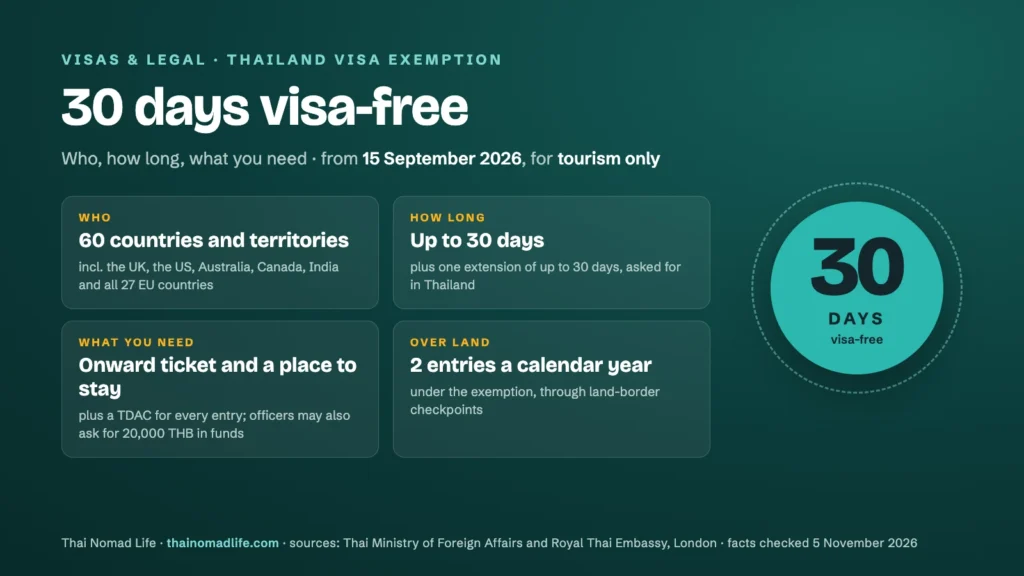
What changed in the Thailand visa exemption on 15 September 2026
| Before 15 Sep 2026 | From 15 Sep 2026 | |
|---|---|---|
| Visa-free stay | 60 days [5] | 30 days [1, 2] |
| Countries and territories on the main list | 93 | 60 [1, 5] |
| Purpose | — | Tourism only [2] |
| Entries over land borders | — | Twice per calendar year under the exemption [2] |
| Visa on arrival | A longer list, including India | 3 countries (Azerbaijan, Belarus, Serbia) [1, 5] |
The Royal Thai Embassy in London states it plainly. Eligible travellers can stay “up to 30 days under the Visa Exemption Scheme for tourism purposes only” [2]. For India, the Royal Thai Embassy in New Delhi confirms that Indian passport holders now come under “the 30-day visa exemption” [3].
Which passports get 30 days visa-free?
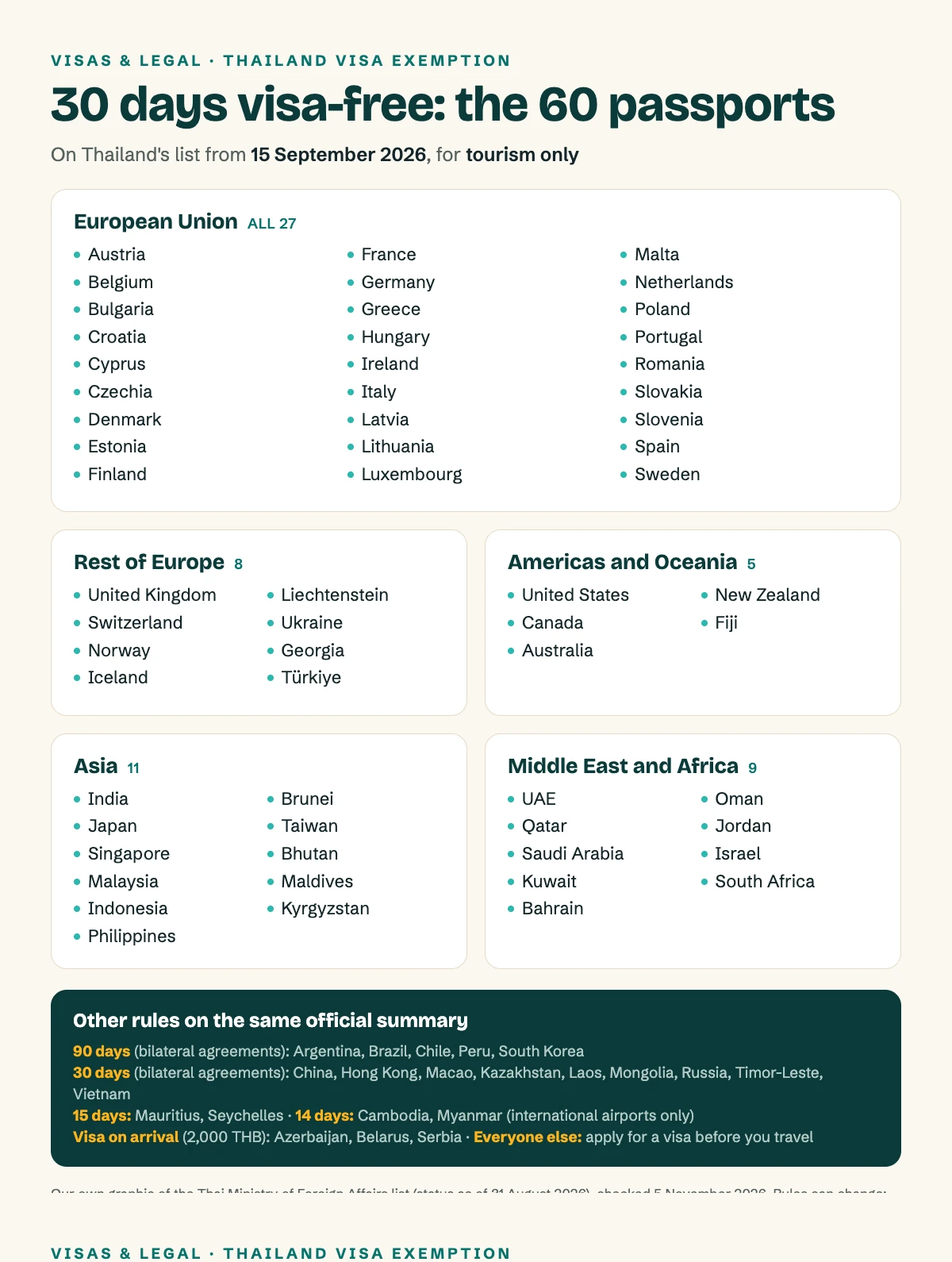
These are the 60 countries and territories on the Ministry of Foreign Affairs’ list, status as of 31 August 2026 [1].
| Region | Countries and territories |
|---|---|
| European Union (all 27) | Austria, Belgium, Bulgaria, Croatia, Cyprus, Czechia, Denmark, Estonia, Finland, France, Germany, Greece, Hungary, Ireland, Italy, Latvia, Lithuania, Luxembourg, Malta, Netherlands, Poland, Portugal, Romania, Slovakia, Slovenia, Spain, Sweden |
| Rest of Europe | United Kingdom, Switzerland, Norway, Iceland, Liechtenstein, Ukraine, Georgia, Türkiye |
| Americas and Oceania | United States, Canada, Australia, New Zealand, Fiji |
| Asia | India, Japan, Singapore, Malaysia, Indonesia, Philippines, Brunei, Taiwan, Bhutan, Maldives, Kyrgyzstan |
| Middle East and Africa | United Arab Emirates, Qatar, Saudi Arabia, Kuwait, Bahrain, Oman, Jordan, Israel, South Africa |
Other arrangements on the same official summary [1]:
- Bilateral agreements:
- 90 days: Argentina, Brazil, Chile, Peru, South Korea.
- 30 days: China, Hong Kong, Macao, Kazakhstan, Laos, Mongolia, Russia, Timor-Leste, Vietnam.
- 14 days: Cambodia, and Myanmar (international airports only).
- 15 days: Mauritius and Seychelles.
- Visa on arrival (fee 2,000 THB): Azerbaijan, Belarus and Serbia only.
- Everyone else must apply for a visa before travelling, on the official Thai e-Visa site [6].
Check your own passport on the official list before you book. The list can change. Holders of travel documents issued by the British or Irish government, as opposed to passports, must apply for a visa [2].
Do I need a visa for Thailand? By passport
| Your passport | For a holiday of up to 30 days | Staying longer |
|---|---|---|
| United Kingdom | No visa needed [1, 2] | Extension of up to 30 days in Thailand, or a visa (see below) |
| United States | No visa needed [1] | Extension of up to 30 days in Thailand, or a visa |
| Australia, New Zealand, Canada | No visa needed [1] | Extension of up to 30 days in Thailand, or a visa |
| Germany, France, Ireland and the rest of the EU | No visa needed [1] | Extension of up to 30 days in Thailand, or a visa |
| India | No visa needed. India moved from visa on arrival to the 30-day exemption [1, 3] | Extension of up to 30 days in Thailand, or a visa |
| South Korea, Brazil, Argentina, Chile, Peru | No visa needed, up to 90 days under a bilateral agreement [1] | — |
| Not on any list | You need a visa before you travel [1, 6] | — |
What “tourism only” means
The Thailand visa exemption covers holidays. The London embassy says it is “for tourism purposes only”, and strongly advises anyone coming for other purposes to apply for an appropriate visa [2].
If you plan to:
- work (including remote work for months);
- study;
- train for months;
look at a visa made for that, such as the Destination Thailand Visa (DTV). Our visa guide for long stays compares the options.
What you need at the border
The London embassy says that on arrival you must show the immigration officer [2]:
- proof of onward travel within 30 days of your arrival;
- proof of accommodation.
The officer may also, at their discretion [2]:
- ask for proof of funds of 20,000 THB per person;
- interview you.
Plus, for every entry:
- a TDAC. Submit it free on the official site in the three days before you arrive [2]. Our TDAC guide goes through it field by field.
The Thailand visa exemption page does not set a passport-validity rule; it mentions six months only for visa on arrival [2]. Entry is always decided by the immigration officer [5].
Can I extend my 30 days?
Yes, once. The London embassy says you may request “an extension of stay for up to 30 days”, and refers you to the Immigration Bureau of Thailand for the requirements and procedures [2]. That gives a maximum of about two months.
How it works:
- You apply in person at an immigration office, before your 30 days end.
- The extension is at the officer’s discretion.
- Check the current fee and documents on the Immigration Bureau’s website before you go.
On Koh Samui, the immigration office is in Mae Nam.
From my own stay (under the old rules)
I arrived in July 2025, when visa-free stays were still 60 days. I extended once, by 30 days, at the Samui immigration office in Mae Nam, and paid 1,900 THB (around September 2025). Since 15 September 2026 the visa-free stay is 30 days, so the same plan would now give you about two months, not three.
How many times can I enter on the Thailand visa exemption?
- Over land: the London embassy says travellers who enter under the exemption “through land-border immigration checkpoints” are “allowed to enter only twice within a calendar year” [2]. That matters for border runs, for example to Malaysia, Laos or Cambodia.
- By air: the page sets no yearly number [2]. Repeated short visits can still be questioned, because admission is at the officer’s discretion [5].
If you want to stay in Thailand for months, plan for a visa rather than a chain of visa-free entries.
Staying longer than two months
| Option | Stay per entry | Extension | Best for |
|---|---|---|---|
| Thailand visa exemption | Up to 30 days | Up to 30 days [2] | A holiday, or a first month on Samui |
| Tourist visa (TR) | Up to 60 days | Up to 30 days, maximum 90 [4] | About three months of tourism |
| Destination Thailand Visa (DTV) | Up to 180 days, multiple entries for 5 years | Once per entry, up to 180 days [4] | Remote workers, Muay Thai and other “soft power” training |
Rules and documents differ by embassy. Apply where you live, on the official Thai e-Visa site [6]. Details: Visas for a long stay on Koh Samui and the DTV for Muay Thai.
What if I overstay?
Do not. The London embassy summarises the penalty for overstaying as “a fine of 500 baht per day and blacklist for entry ban for at least 5 years” [4]. If your plans change, extend before your stamp expires.
Frequently asked questions
Do US citizens need a visa for Thailand?
Not for tourism of up to 30 days. The United States is on the 30-day exemption list [1].
Do UK citizens need a visa for Thailand?
Not for tourism of up to 30 days. British passport holders are on the list; British travel document holders need a visa [1, 2].
Do Australians need a visa for Thailand?
Not for tourism of up to 30 days [1].
Do Indians need a visa for Thailand?
Not for tourism of up to 30 days. India moved from visa on arrival to the 30-day exemption on 15 September 2026 [1, 3].
Is visa on arrival still available?
Only for passports from Azerbaijan, Belarus and Serbia, for a fee of 2,000 THB [1].
Can I work remotely on the Thailand visa exemption?
The exemption is for tourism only [2]. For long periods of remote work, the DTV is the visa designed for it. See our visa guide.
Do children need a visa?
The same rules apply to every passport holder, children included. Each traveller, including babies, also needs their own TDAC; see our TDAC guide.
I entered before 15 September 2026 on 60 days. Am I affected?
Reports say travellers who entered before 15 September keep the stay they were granted [5]. Check your entry stamp; the date on it is what counts.
More in Visas & Legal

How we know this
- On 5 November 2026 we read the Ministry of Foreign Affairs’ summary of the 2026 visa-exemption scheme (status 31 August 2026) and the Royal Thai Embassy pages in London and New Delhi, and read every source again just before publishing.
- We added an immigration law firm’s alert for details the embassy pages do not cover.
- Ismail’s extension is his own, from September 2025, under the rules of that time.
- Rules can change at short notice. Check the official pages before you travel.
Sources
- Summary: The revision of Thailand’s visa exemption and VoA schemes, 2026 (for ordinary passport holders), Ministry of Foreign Affairs, Kingdom of Thailand, effective 15 Sep 2026, status as of 31 Aug 2026, read 5 Nov 2026
- Visa Exemption and Visa on Arrival Schemes, Royal Thai Embassy, London (effective 15 Sep 2026), read 5 Nov 2026
- The revision of Thailand’s visa exemption and VoA schemes, 2026 (for ordinary passport), effective from 15 September 2026, Royal Thai Embassy, New Delhi, 15 Sep 2026
- Tourist Single Entry Visa, Royal Thai Embassy, London (updated 4 Apr 2024); Destination Thailand Visa (updated 8 Sep 2026); Validity of visa and permitted length of stay (updated 2 Nov 2026)
- Thailand: Reduction in Visa-Exempt Stay Duration Forthcoming, Fragomen, 1 Sep 2026, updated 18 Sep 2026
- Thai e-Visa (official application site), Ministry of Foreign Affairs